Behind-the-Ear vs In-the-Ear Hearing Aids: Which One Is Right for You?
Hearing aids are there to help people with their hearing and make their lives better. However, managing those hearing aids is another task, and it certainly doesn’t make anything easier. Studies show that 3.21 million Canadians are suffering from ear defects; there can be multiple causes, but the post-treatment problems are the same. Aids not fitting, causing pain or discomfort, hearing is improving, but still doesn’t feel real, and many more.
So, who is at fault, your hearing aid practitioner? Mmm, we don’t think so. See, hearing is a very subjective thing, and to get the perfect aid, you must convey your problems or preferences clearly.
Yes, in this blog, we will discuss the same. Primarily, there are two types of hearing aids: first, behind-the-ear, and second, one is in-the-ear. Now, you need to decide which one would suit you better, and to do that, you need to know everything about them. So, here we go:
What Are Behind-the-Ear (BTE) Hearing Aids?
Let’s start with the one you’ve probably seen the most. Behind-the-Ear hearing aids are the ones most people picture when they think of hearing aids. And honestly, there’s a reason they’ve been around for so long: they work exceptionally well.
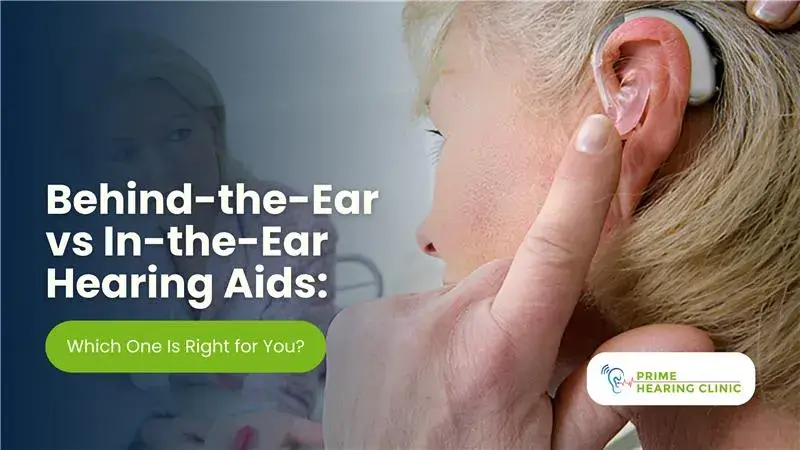
The main unit of a BTE hearing aid sits snugly behind your outer ear. From there, a thin tube or wire connects it to a small earmold or ear tip that is placed in your ear canal. This is where the sound the sounds, amplified, processed, and tailored to your specific level of hearing loss gets delivered. The casing behind your ear holds all the important bits: the microphone, amplifier, sound processor, and battery.
Now, because the device has more physical space to work with, your hearing aid practitioner can fit it with more powerful technology. This is exactly why BTE aids are so versatile. They can be adjusted and programmed to handle an extensive range of hearing loss issues.
There are also a few variations worth knowing. Standard BTE devices are the most powerful. Mini BTE models are a bit slimmer and less noticeable. Then there’s the Receiver-in-Canal (RIC) style, in which, the speaker is placed directly inside the ear canal. Many users prefer this for a more natural sound experience.
In short, BTE hearing aids are reliable, powerful, and suitable for almost everyone. If you’re just starting your hearing care journey, they’re the best match.
Key Features
- Suitable for mild to severe hearing loss.
- Larger casing, which enables more powerful amplification and better processing capability.
- Longer battery life, with both disposable and rechargeable options.
- Easier to handle, making it suitable for seniors or those with limited dexterity.
- It can be connected via Bluetooth to wireless hearing devices and other assistive listening devices.
- Available in multiple sizes, including discreet mini and RIC versions.
- Custom earmold options for a secure, personalized fit.
- Generally, more durable and easier to service or repair.
What Are In-the-Ear (ITE) Hearing Aids?
Now here’s where things get interesting. If your biggest concern is discretion, which means you don’t want people to know that you are wearing a hearing aid, then In-the-Ear hearing aids are likely going to catch your attention.
Unlike BTE devices, ITE hearing aids don’t sit behind the ear. They fit entirely within the ear itself. The microphone, amplifier, processor, and battery are packed into a single custom-molded shell shaped specifically to the contours of your ear canal. Yes, custom-made just for you. Your hearing aid practitioner takes an impression of your ear, and the device is crafted to fit as if it were born there.
Because the microphone sits right where sound naturally enters the ear, many users report a more organic, realistic sound experience. Your brain is used to receiving sound from inside the ear, so ITE devices can feel more natural right from the start, like your own hearing doing its job again.
ITE aids come in a range of sizes. Full Shell models fill the outer bowl of your ear and are the easiest to handle. Half-shell models are a little smaller. In-the-Canal (ITC) styles are mostly hidden, Completely-in-Canal (CIC) models are largely invisible, and Invisible-in-Canal (IIC) devices sit so deep in the canal that most people standing right next to you won’t even notice them.
The trade-off? They are best suited for mild to moderately severe hearing loss. If your condition is on the more severe end, your doctor will advise you on whether an ITE device can still meet your needs or a BTE would still serve you better.
Key Features
- Fits entirely within the ear, ranging from partially visible to completely invisible
- Custom-molded to your exact ear shape, enabling a better fit.
- Suited for both mild and moderately severe hearing loss
- Produces a more natural sound experience due to the microphone placement inside the ear
- Significantly reduced wind noise compared to BTE devices
- Ideal for professionals, younger adults, or appearance-conscious users.
- Some models offer Bluetooth connectivity and smartphone app control
- No external tubes or wires. Nothing to interfere with glasses or headwear
BTE vs ITE: A Side-by-Side Comparison
Did you read everything from the start, but are still a bit confused about the actual difference between these two devices for your hearing? No worries, it happens because some of the aspects are actually quite similar. Below is a clear comparison of these devices on various factors:
Comfort & Fit
BTE hearing aids rest behind the ear, so your ear canal stays mostly open and unobstructed. Most users find them comfortable for all-day wear. The only occasional complaint is that they can rub slightly against the skin, especially in warmer weather or when wearing glasses, and cause irritation.
ITE hearing aids, on the other hand, are custom-molded to match the exact shape of your ear canal. When fitted correctly by a qualified hearing aid practitioner, they sit so naturally that many users forget they are wearing them. However, if you have a sensitive ear canal, you may need a short adjustment period before you feel completely comfortable.
Visibility & Discretion
This one is straightforward. BTE devices are visible behind the ear. Modern versions have become much slimmer and smaller than older models, but they are still noticeable up close.
ITE devices sit inside the ear. Depending on the style you choose, they range from slightly visible to completely invisible. CIC and IIC styles in particular sit so deep in the canal that people standing right next to you likely won’t spot them at all. If keeping your hearing aid private matters to you, ITE is the clear winner here.
Ease of Use & Maintenance
BTE hearing aids are larger, which makes them much easier to pick up, insert, remove, and clean. For older adults or anyone who struggles with small objects, this is a genuine daily convenience.
ITE devices are smaller and require a steadier hand during insertion and removal. They also sit closer to the ear canal, which means earwax buildup can be a more frequent issue and requires more careful, regular cleaning. Both styles need routine maintenance, but BTE hearing aids are generally considered the lower-effort option in day-to-day use.
Sound Quality
Both BTE and ITE hearing aids deliver excellent sound quality with modern digital technology, so neither has an overwhelming advantage here. However, there is a subtle difference. ITE devices sit inside the ear, which gives many users a more realistic, true-to-life listening experience.
BTE devices, particularly the RIC style, are known for sharp, clear sound even in noisy environments like restaurants or busy streets. Your ENT doctor can help you understand which sound profile best suits your listening habits.
Battery Life & Power
Because BTE hearing aids have a larger casing, they can fit bigger batteries. This means longer usage time between charges or battery replacements. Many BTE models today are fully rechargeable and last an entire day on a single overnight charge.
ITE devices use smaller batteries that typically need to be replaced more frequently. Rechargeable ITE options do exist, but they are not as widely available across all price ranges. If you find battery management inconvenient or easy to forget, BTE hearing aids are the more practical choice.
Suitability for Degree of Hearing Loss
This is the most important factor of all, and it is the one your hearing aid practitioner will assess first. BTE hearing aids can handle the full range of hearing loss, from mild to profound. Their size allows for more powerful amplification and advanced sound processing, which is why they are often the recommended choice for significant hearing loss.
ITE hearing aids work very well for mild to moderately severe hearing loss. Beyond that range, they may not provide sufficient amplification to make a meaningful difference. Simply put, the greater your hearing loss, the more likely a BTE device is the right fit for you.
Factors to Consider When Making Your Decision
Okay, so we have looked at the fittings, the sound quality, and the aesthetics as well. But you also need to consider other factors when choosing a hearing aid. They are as follows:
Degree of hearing loss
This is always the starting point. Before anything else, your doctor will assess how mild or severe your hearing loss is, because that alone can determine which style is even a viable option for you. If your hearing loss falls within the mild-to-moderate range, both BTE and ITE devices can work well. If your loss is severe or profound, BTE is almost always the recommended route because it simply delivers more power. Never choose a hearing aid based on looks or price alone before understanding the degree of your hearing loss. Get tested first, then decide.
Lifestyle
Yes, your lifestyle also determines which hearing aid suits you best. If you are someone who is mostly at home in quieter settings, ITE will suit you better.
However, if you lead a very active lifestyle, such as playing sports, going to the gym, hiking, or spending time in noisy environments, BTE would be the perfect match for you, as they are more durable. Your hearing aid practitioner will ask about your daily routine for exactly this reason. The right hearing aid should keep up with your life, not slow it down.
Dexterity
This is a factor many people overlook until it becomes a daily frustration. Hearing aids are small devices, and handling them requires a reasonable level of finger control. If you have arthritis, tremors, or any condition that affects the steadiness of your hands, a smaller ITE device can become genuinely difficult to manage every single day.
BTE hearing aids are larger, easier to grip, and simpler to insert and remove. For seniors or anyone who already finds small objects challenging to handle, this practical consideration can make a big difference in whether you actually wear your hearing aid consistently or leave it sitting in a drawer.
Budget
Hearing aids are an investment, and cost is a real factor for most people. Both BTE and ITE devices are available across a wide price range. However, custom-molded ITE devices tend to be priced higher at the entry level due to the customization involved.
BTE hearing aids often offer more flexibility in terms of what you get for your budget. At Prime Hearing Clinic, we work with AADL, WCB, IFHP, and most private insurance providers to make hearing care as affordable as possible.
Aesthetics
There is absolutely nothing wrong with wanting your hearing aid to look a certain way. How you feel about wearing it affects whether you wear it at all. If you would prefer something that nobody notices, ITE devices, particularly CIC and IIC styles, are designed with that in mind.
If you are comfortable with a device that sits behind the ear and would rather prioritize power and ease of use over invisibility, BTE is a perfectly confident choice. Modern BTE devices also come in a variety of colours and slim designs, far beyond the bulky styles of older generations. Wear what makes you feel good.
Technology needs
Hearing aid technology has come a long way. Today’s devices can connect to smartphones, stream audio directly from your TV, automatically adjust to different sound environments, and even track health data. If these features matter to you, it is worth knowing that BTE hearing aids, due to their larger size, tend to support a wider range of advanced features and accessories.
That said, many ITE models now include Bluetooth connectivity and app-based controls. Think about what technology would genuinely improve your daily experience and discuss those needs with your hearing aid practitioner during your consultation. The right features can make a good hearing aid feel like a great one.
Frequently Asked Questions