
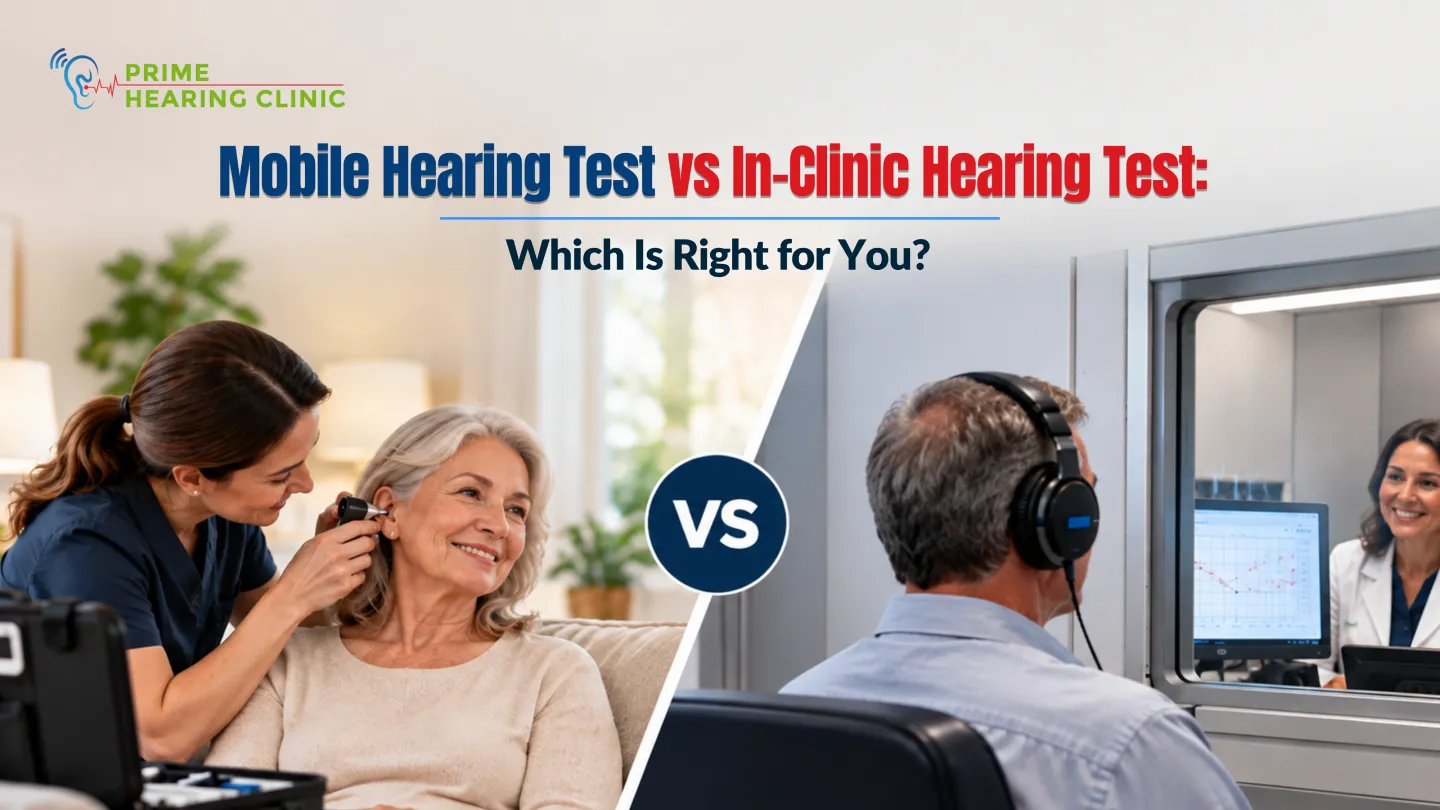
A mobile hearing test is a professional hearing assessment that is done at your home, workplace, or care facility, while an in-clinic hearing test takes place at a hearing clinic. Both tests use professional equipment and guidance from a hearing professional.
The main difference is location. Mobile testing brings the assessment to you, while in-clinic testing requires you to visit the clinic. The right option depends on your hearing needs and how easily you can access professional care.
Nowadays, it’s easier than ever to get your hearing checked without having to travel far for professional care.
A mobile hearing test brings hearing care to your home, workplace, or care facility, making it a convenient option if you have started wondering about your hearing. With a mobile appointment, you can have your hearing tested in a familiar and convenient setting without travelling to a clinic.
An in-clinic hearing test, on the other hand, requires you to visit a hearing clinic for your assessment. It provides a dedicated clinical setting with professional hearing equipment, where you can have your hearing assessed and discuss your results with a hearing professional.
So, which option makes sense for you? In this blog, we’ll explain how mobile and in-clinic hearing tests differ and help you understand which one may be right for your needs.
A mobile hearing test is a professional hearing assessment performed outside a traditional clinic. Instead of travelling to the clinic, a hearing professional comes to your location.
The mobile hearing team travels with a fully equipped mobile clinic and professional hearing assessment equipment. The service is designed to make professional hearing care more accessible for people who may have difficulty travelling to a clinic or simply prefer the convenience of being tested at their location.
A mobile hearing assessment can evaluate areas such as:
The exact assessment can vary depending on your hearing needs, but the process may include:
The assessment takes place at the location arranged for your appointment, such as your home, workplace, or care facility.
If you want to learn more about how mobile hearing services work in Calgary, read our guide to mobile hearing tests in Calgary and what to expect from professional hearing care at your location.
An in-clinic hearing test is a professional examination performed by an audiologist to measure how well you detect sounds across different pitches and volumes.
The appointment usually starts with a consultation about your hearing concerns and relevant history. Depending on your needs, the assessment may include an ear examination, pure-tone audiometry, speech testing, and middle-ear testing such as tympanometry.
The goal is not simply to tell you whether you can hear a sound. A professional assessment looks at your hearing in more detail and helps you understand what the results mean.
Your appointment may include several steps.
A full hearing assessment usually takes about 30–60 minutes, including the consultation, testing, and review of the results.
The main difference between these two options is not necessarily the purpose of the assessment. It is primarily where the assessment takes place and how you access professional hearing care.
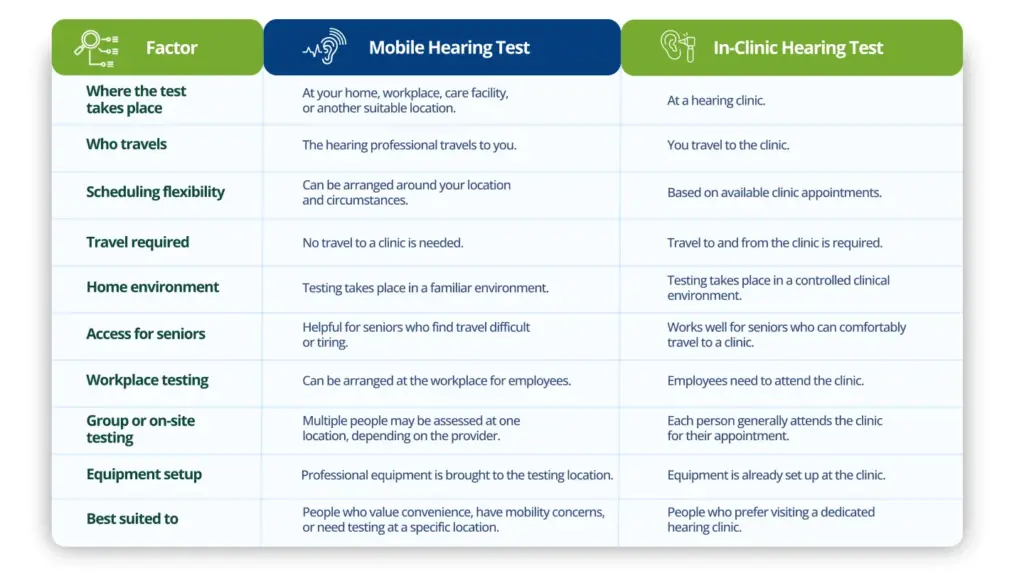
Both options can provide professional hearing care. The more practical choice depends largely on your location, mobility, schedule, and personal preferences.
A mobile hearing test and an in-clinic hearing test are designed for different levels of hearing assessment. Both tests have their own advantages and limitations. Let’s look at the pros and cons of these tests so that you can choose the best option.
1. Professional Hearing Care at Your Location
You do not have to arrange transportation to a hearing clinic. The assessment can take place at your home, workplace, or care facility, depending on the service arrangement.
2. Helpful For People With Mobility Challenges
Travelling to an appointment can be difficult for some people. A mobile hearing assessment can reduce some of the practical challenges of getting to a clinic.
This can be particularly useful for seniors, people with mobility limitations, and family caregivers arranging hearing care for someone else.
3. Convenient for Seniors
Older adults may find it easier to receive hearing care at home rather than arrange transportation to a clinic. With a mobile hearing test, a hearing professional can come to their home or another suitable location, allowing them to have their hearing assessed without the need to travel to a clinic.
1. Assessment Takes Place Outside a Traditional Clinic
Although professional equipment is brought to the appointment, the setting is different from a dedicated hearing clinic. The available space and environment may depend on the location.
2. Not Every Hearing Service Is Available In Every Location
Mobile services can vary depending on the provider, location, and type of assessment required. If a specific test or additional medical evaluation is needed, your hearing professional can explain what should happen next.
3. A Suitable Testing Area May Be Needed
A quiet and appropriate space can help make the assessment easier to conduct. Your hearing professional can advise you about preparing the location before the appointment.
1. Several Parts of Your Hearing Can Be Assessed
A professional assessment can include several tests rather than relying on a single online screening result. Depending on the assessment, this may include pure-tone audiometry, speech testing, tympanometry, and an ear examination.
Pure-tone testing can show how softly you hear different frequencies in each ear. The results are plotted on an audiogram, giving the hearing professional a clearer picture of your hearing sensitivity.
2. Testing Takes Place Under Controlled Conditions
Background noise matters during hearing testing. A professional setting is designed to reduce distractions and keep testing conditions suitable for reliable results.
3. You Can Discuss The Results With A Professional
You do not have to work out what your result means on your own. A hearing professional can explain the results, discuss any concerns you have, and recommend the next step based on your hearing needs.
1. It Takes More Time
A full hearing assessment usually takes around 30–60 minutes, depending on the testing needed. It can involve an initial consultation, complete tests, and test assessment.
2. You Need To Plan A Visit
An in-clinic hearing assessment requires you to schedule an appointment and travel to the clinic at the arranged time. This can take additional planning, particularly for senior citizens, people with limited mobility, or those who rely on someone else for transportation.
3. It May Include More Testing Than You Expected
A professional assessment may include several tests because each provides different information about your hearing. That extra testing is useful when you want to understand why you are having difficulty hearing, rather than simply finding out whether you can hear certain sounds.
There is no single option that works for everyone. Both mobile and in-clinic hearing tests can provide access to professional hearing assessment, but the more suitable setting depends on your circumstances.
With mobile hearing services available at homes, workplaces, and care facilities, professional hearing assessments can be provided outside the traditional clinic setting.
The important point is to choose a setting that makes it practical for you to receive the hearing care you need.
For many senior citizens, a mobile hearing test can be a practical way to have their hearing assessed without the need to travel to a clinic. Hearing loss also becomes more common with age. Research shows that more than 2.75 million Canadian seniors live with hearing loss, highlighting the importance of accessible hearing assessment for older adults.
A mobile assessment can be particularly useful for seniors who have difficulty travelling, rely on family members or caregivers for transportation, or live in a care facility. However, whether mobile testing is enough depends on the individual’s hearing concerns and the type of assessment required. A hearing professional can determine whether further testing, examination, or follow-up care is needed based on the results.
For seniors who have noticeable changes in hearing, communication difficulties, or other ongoing concerns, the goal should not simply be to complete a hearing test but to ensure those concerns are properly assessed and addressed.
A mobile hearing test can be a convenient way to start paying attention to your hearing, especially when you want a quick screening from home. But if you have ongoing concerns, a professional assessment can give you a much clearer understanding of your hearing.
At Prime Hearing Clinic, you can choose between in-clinic and mobile hearing assessments in Calgary based on what works best for you. Our team can explain your results clearly and help you understand the next steps for your hearing health.
Assistive Listening Devices Bluetooth hearing aids Custom earmolds Custom earplugs in Calgary hearing-aid practitioners in Calgary hearing aid clinic in Calgary hearing aid clinics in Calgary hearing aid devices Hearing aid practitioners Hearing aid practitioners in Calgary Hearing Aids hearing aids in Calgary hearing care services in Calgary hearing clinic in Calgary hearing clinics in Calgary hearing health clinic in Calgary Hearing Protection Hearing Screening Hearing Test hearing test in Calgary hearing tests in Calgary Hidden Risk of Cotton Swabs in-clinic hearing test Sudden Hearing Loss Wireless Hearing Aids wireless hearing devices
We Speak Your Language

Supporting individuals and families across Alberta with better hearing through expert care, advanced technology, and compassionate service, both in-clinic and in-home.
ਸਾਡਾ ਮਿਸ਼ਨ ਹੈ ਕਿ ਹਰ ਕੋਈ ਵਧੀਆ ਢੰਗ ਨਾਲ ਸੁਣ ਸਕੇ—ਕਿਉਂਕਿ ਸੁਣਨਾ ਜ਼ਿੰਦਗੀ ਨਾਲ ਜੁੜਨ ਦਾ ਸਾਧਨ ਹੈ।
Copyright © 2026 Prime Hearing Clinic. All Rights Reserved.
Powered By Cyber Ace
Our booking services are currently available exclusively in Canada. We’re sorry, but bookings from outside Canada are not currently supported.