
Are you beginning to notice that sounds seem quieter in one ear? Maybe you’re experiencing a blockage in either ear, sounds seem muffled, or you may be asking people to repeat what they said.
Hearing loss in one ear can happen for several reasons, both common and severe. In fact, the World Health Organization (WHO) reports that about 1 in 5 people worldwide currently live with some degree of hearing loss. Sometimes, hearing loss in one ear can be as simple as earwax buildup or an ear infection. In other cases, reduced hearing in one ear can be linked with damage to the inner ear or auditory nerve and may require immediate medical attention.
If you or someone you know is experiencing hearing loss in one ear, a professional hearing assessment can help identify whether hearing has actually changed and whether further medical evaluation is needed.
Hearing loss in one ear is also known as unilateral hearing loss in medical terms. It happens when hearing is reduced in one ear, and the other ear has better or normal hearing.
The degree of hearing loss can, however, vary from person to person. Some people may experience a slight reduction and only notice mild difficulty understanding speech in noisy environments. Others may experience a sudden or profound hearing loss.
You may describe the problem as:
Hearing loss does not always come with pain. In fact, hearing loss in one ear with no pain can still be worth assessing if the change appears suddenly.
There are several causes of hearing loss in one ear, and a proper hearing assessment is important to identify these causes rather than relying on symptoms alone.
Earwax, also medically known as cerumen, can block the ear canal and interfere with the transmission of sound. If the blockage happens in one side of the ear, you may notice that one side sounds quieter or muffled. Hearing loss in one ear from earwax is generally a conductive hearing problem because sound is physically prevented from travelling normally through the ear canal.
Fluid accumulations behind the eardrum or middle-ear infections can affect how sound travels through the ear.
An infection in the ear may cause:
Your hearing may come back to normal after infections get treated. A persistent change in hearing following an ear infection should be professionally evaluated.
Constant exposure to loud noise or sounds can damage the delicate structures of the inner ear. This can happen for several reasons, including:
Noise-induced hearing loss can be both temporary and permanent. Protecting your ears around loud sounds is an important part of long-term hearing health.
The eardrum is also called the tympanic membrane. It helps transmit sound vibrations into the middle ear.
Damage to the eardrum or perforation can happen for several reasons, including infections, injury, pressure changes, or exposure to very loud sound. If you experience hearing loss after an injury or sudden pressure change, seek professional assessment.
Hearing loss can also happen due to age-related factors and commonly affects both ears. However, it is not necessary that hearing declines equally on both sides. If you notice that one ear hears worse than the other, don’t assume automatically that it’s a part of normal aging. A professional assessment at a hearing test clinic can help identify the issue and provide a baseline for monitoring future changes.
Your inner ear consists of the cochlea and other delicate structures that are responsible for converting sound vibrations into electrical signals that travel to the brain.
Damage that affects the inner ear can result in sensorineural hearing loss. This type of hearing loss is usually associated with:
Because there can be several reasons for inner ear hearing loss, a professional evaluation is important.
Hearing depends not only on the ear but also on the pathway that carries sound information to the brain. In some cases, hearing loss affecting one ear may involve the auditory nerve or other parts of the hearing pathways.
An assessment with a hearing health clinic can identify patterns of hearing loss that may indicate the need for additional medical assessment.
Noticing a change in one ear?
Don’t leave it unchecked. Book a consultation to discuss your concerns, get your hearing assessed, and understand your options.
Sudden hearing loss in one ear should never be ignored. Sudden sensorineural hearing loss can develop quickly and may be noticed when you wake up, after a loud sound, or during normal daily activities.
Sometimes sudden hearing loss can initially feel similar to earwax buildup, pressure, or congestion. For this reason, it is easy to wait and see if it improves.
However, please note that sudden hearing loss or one that is developing rapidly requires immediate medical assessment. Do not wait several days hoping that it will get better on its own.
If you suddenly lose hearing in one ear, contact a healthcare professional promptly to determine the appropriate evaluation and treatment pathway.
Hearing loss in one ear may come with several symptoms. You may notice many or all signs below:
In some people, hearing loss is also accompanied by dizziness or tinnitus. All these symptoms should be discussed with a hearing care specialist.
In some cases, causes of unilateral hearing loss can be temporary. Hearing can be reduced for several reasons:
However, you cannot identify the main cause of hearing loss based on symptoms alone. If your hearing does not improve or continues to fluctuate, a professional hearing assessment can help determine what is happening.
A hearing test plays an important role in evaluating unilateral hearing loss. During a professional assessment, a hearing professional may ask about:
A hearing test helps to measure how well you detect sounds at different volumes and frequencies. Depending on your symptoms and test results, further assessment may be recommended.
A hearing test clinic, like Prime Hearing in Calgary, can offer a detailed assessment to determine whether hearing loss is present and what type of hearing loss may be involved.
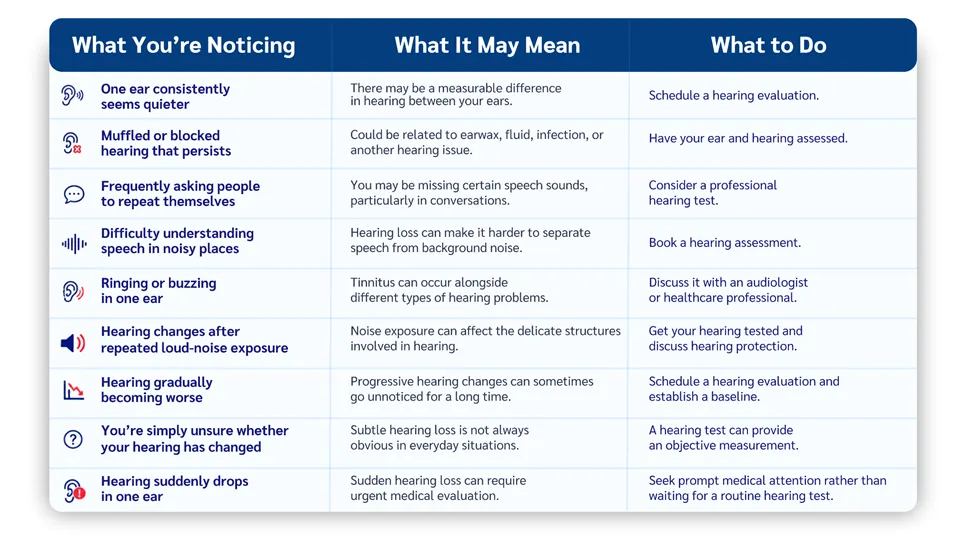
Important: If hearing in one ear suddenly decreases or disappears, don’t wait to see whether it improves on its own. Seek prompt medical attention.
If you have been noticing sudden hearing loss in one ear, muffled hearing, or a gradual change in how you hear, getting a professional assessment is an important first step.
Prime Hearing Clinic is a Calgary hearing care clinic that offers personalized hearing assessments, hearing aid solutions, hearing aid repairs, and ongoing support for adults. Located within Apex Sky Medical Centre, the clinic focuses on making hearing care accessible and easy to understand rather than relying on a one-size-fits-all approach.
We offer a range of hearing care services for every adult’s individual needs. Our services include:
Our team also offers support for major hearing aid brands and can help with adjustments when your hearing device is not performing as expected.
We also offer comprehensive hearing tests in Calgary. A professional assessment can include a consultation about the concerns that you are facing and your medical history to offer the right solutions.
Our clinic also provides hearing screenings for occupational requirements, including RCMP, Calgary Police, CN/CP Rail, and other job-specific needs. Results are explained clearly so patients can understand what their hearing test means and what options may be appropriate for their situation.
For people who find it difficult to travel to a clinic, Prime Hearing Clinic also offers mobile hearing tests in Calgary. Our mobile hearing service can bring hearing care to your home, workplace, or care facility, making assessment more convenient for seniors, people with mobility challenges, busy professionals, and others.
For someone experiencing hearing loss in one ear, a personalized approach can go a long way toward effective treatment.
Hearing loss in one ear can have a straightforward explanation, but it can also hint at a condition that requires timely evaluation. Whether you’re someone experiencing a gradual reduction in your hearing, sounds are suddenly muffled, or one ear simply doesn’t seem to work as well as it used to, getting your hearing checked can provide answers.
Don’t try to diagnose the cause based on symptoms alone.
A professional hearing assessment can help identify whether hearing loss is present, find out the differences between your ears, and guide you toward the right next step.
Don’t wait and wonder. Book a hearing test with Prime Hearing Clinic in Calgary to understand what’s affecting your hearing and explore the right care for you.
Assistive Listening Devices Bluetooth hearing aids Custom earmolds Custom earplugs in Calgary hearing-aid practitioners in Calgary hearing aid clinic in Calgary hearing aid clinics in Calgary hearing aid devices Hearing aid practitioners Hearing aid practitioners in Calgary Hearing Aids hearing aids in Calgary hearing care services in Calgary hearing clinic in Calgary hearing clinics in Calgary hearing health clinic in Calgary Hearing Protection Hearing Screening Hearing Test hearing test in Calgary hearing tests in Calgary Hidden Risk of Cotton Swabs in-clinic hearing test Sudden Hearing Loss Wireless Hearing Aids wireless hearing devices
We Speak Your Language

Supporting individuals and families across Alberta with better hearing through expert care, advanced technology, and compassionate service, both in-clinic and in-home.
ਸਾਡਾ ਮਿਸ਼ਨ ਹੈ ਕਿ ਹਰ ਕੋਈ ਵਧੀਆ ਢੰਗ ਨਾਲ ਸੁਣ ਸਕੇ—ਕਿਉਂਕਿ ਸੁਣਨਾ ਜ਼ਿੰਦਗੀ ਨਾਲ ਜੁੜਨ ਦਾ ਸਾਧਨ ਹੈ।
Copyright © 2026 Prime Hearing Clinic. All Rights Reserved.
Powered By Cyber Ace
Our booking services are currently available exclusively in Canada. We’re sorry, but bookings from outside Canada are not currently supported.