Traditional vs. Bluetooth Hearing Aids

Traditional vs. Bluetooth Hearing Aids in Calgary: Which Option Is Right for You?

Hearing loss is one of the most common health challenges people experience at some point in their lives. It can interrupt your daily routine, make conversations more difficult, and affect your confidence in social situations. The good news? Today’s hearing technology offers more solutions, support, and treatment options than ever before. In many cases, the help available is far greater than the problem itself.

Among the latest measures are Bluetooth hearing aids in Calgary. These allow users to stream phone calls and music, and other audio, directly to their hearing aids. They also offer greater control through smartphone apps. Alongside these modern devices, there are also traditional hearing aids that continue to provide reliable hearing support for many users.

If you’re exploring hearing aids for yourself or a loved one, understanding the different types of hearing aids and the features available can help you make an informed decision.

Different Types of Hearing Aids

Hearing aids come in several styles to suit different levels of hearing loss and lifestyles. Your hearing care clinic will recommend a style based on your hearing needs, ear anatomy, and daily activities.

Below are the most common types of hearing aid devices in Calgary

1.   Behind-the-Ear (BTE)

  • BTE hearing aids sit behind the ear with a tube connecting to an earmold or tube.
  • These are suitable for mild to profound hearing loss.

Pros:

  • Easy to manage and clean
  • Powerful amplification
  • Long battery life
  • Can include rechargeable batteries

Cons:

  • Most visible style

2.   Receiver-in-Canal (RIC) / Receiver-in-the-Ear (RITE) 

  • These are similar to BTE hearing aids, but the speaker sits inside the ear canal.
  • Suitable for mild to severe hearing loss.

Pros:

  • Smaller and more discreet than BTE
  • Natural sound quality
  • Less “plugged-up” feeling

Cons:

  • Receiver may require more maintenance due to earwax

3.   In-the-Ear (ITE)

  • Custom-made to fit the outer ear.
  • Suitable for mild to severe hearing loss.

Pros:

  • Easy to insert and remove
  • Larger controls
  • Can accommodate more features

Cons:

  • More visible than smaller in-ear models

4.   In-the-Canal (ITC)

  • Fits partly inside the ear canal.
  • Suitable for mild to moderately severe hearing loss.

Pros:

  • Less visible than ITE
  • Provides a comfortable fit

Cons:

  • Smaller batteries
  • Fewer features due to size

5. Completely-in-Canal (CIC)

  • Fits almost entirely inside the ear canal.
  • Suitable for mild to moderate hearing loss.

Pros:

  • Very discreet
  • Reduced wind noise

Cons:

  • Small batteries
  • Difficult to handle for some people
  • Limited room for advanced features

6. Invisible-in-Canal (IIC)

  • Fits deep inside the ear canal and is almost invisible.
  • Suitable for mild to moderate hearing loss.

Pros:

  • This option is the most discreet
  • Offers natural sound because of deep placement

Cons:

  • Not suitable for everyone
  • Very small batteries
  • Requires good manual dexterity

Special Types

  • CROS hearing aids: These are for people with hearing loss in one ear and normal hearing in the other.
  • BiCROS hearing aids: For people with one unaided ear and hearing loss in the better ear.
  • Bone-conduction hearing devices: Used for certain conductive hearing losses or single-sided deafness. These transmit the sound through bone instead of the ear canal.

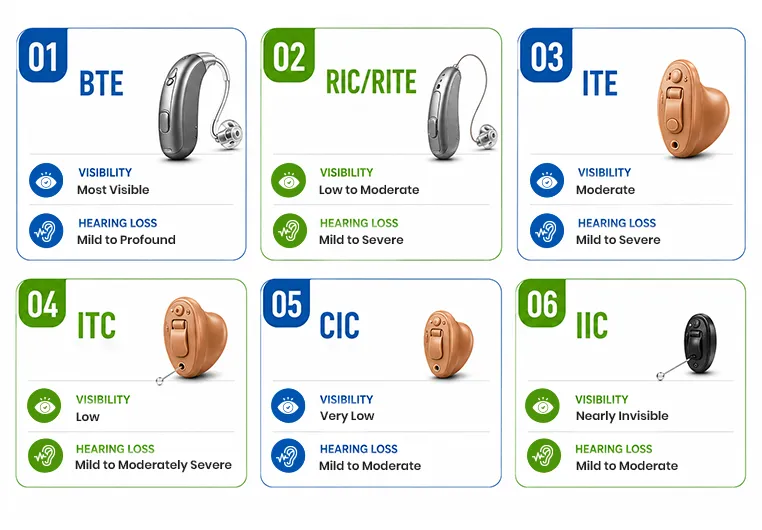
Quick Comparison Table:

Types of hearing aids: BTE, RIC/RITE, ITE, ITC, CIC and IIC

Modern Hearing Aid Technology: Bluetooth Connectivity

One of the most requested features in modern hearing aid devices is Bluetooth connectivity. The feature allows users to seamlessly connect to the devices they use every day. Rather than being a separate type of device, Bluetooth in hearing aids is a built-in technology available in BTE, RIC, and some ITE models.

Bluetooth hearing aids enable users to stream phone calls, music, podcasts, and other media directly from compatible smartphones, televisions, and computers, among others. Many models also pair with smartphone apps, making it easy to adjust volume, switch programs, and monitor battery status. 

Several models are also rechargeable hearing aids. These eliminate the need to replace disposable batteries. Rechargeable options provide a full day’s run on a single charge, making them a convenient and environmentally friendly choice for everyday use.  

Benefits of Bluetooth Hearing Aid Technology:

  • Provide direct streaming of phone calls, TV audio, and podcasts.
  • Offer hands-free calling with compatible smartphones.
  • Easy control through a smartphone app.
  • Available in many rechargeable hearing aids for more convenience
  • Clearer and more personalized listening experience.

Things to Consider:

  • One of the most common things with Bluetooth streaming is more battery consumption as compared to standard options.
  • Compatibility and features may depend on the model of the hearing aid, brand, and smartphone operating system.
  • Bluetooth connectivity is a feature, not a hearing aid style. This should be considered alongside the type of hearing aid that best suits your hearing needs and lifestyle.

As hearing aid technology continues to evolve, Bluetooth connectivity and rechargeable hearing aids have become a standard feature in many modern devices.

What Traditional Hearing Aids Offer for Hearing Loss

Traditional hearing aids have been around for decades, helping people carry out their day-to-day activities with ease.

Benefits of Traditional Hearing Aids

  • Traditional hearing aids focus on improving hearing accuracy by using technology that works well for hearing loss of different levels.
  • Traditional hearing aids are suitable for people who prefer straightforward controls, including manual buttons or wheels for volume, easy program changes, and do not require apps or data syncing.
  • These hearing aids do not offer the same features as Bluetooth hearing aids, but still offer strong speech clarity, making it easier for the user to follow everyday activities with ease.
  • Traditional hearing aids tend to be more budget-friendly than wireless or Bluetooth models. For people who don’t need streaming or smartphone features, they offer excellent value.
  • Traditional hearing aids have a longer battery life as they do not require wireless streaming, reducing the need for frequent charging.

For more information about hearing aids and their suitability for you, it’s best to consult our hearing clinic in Calgary for a personalized recommendation.
Limitations of Traditional Hearing Aids

  • Traditional hearing aids can not connect to smartphones, TVs, or other devices, which means phone calls may sound unclear and you may struggle to hear TV, music, and media.
  • Traditional devices amplify all sound, not just speech. This can make it harder to follow conversations in restaurants, hear speech at social events, and understand coworkers in busy workplaces.
  • Traditional hearing aids rely on manual control for their operations and have limited listening programs.
  • These hearing aids do not use modern wireless processing; traditional aids may produce more mechanical and less natural sound.

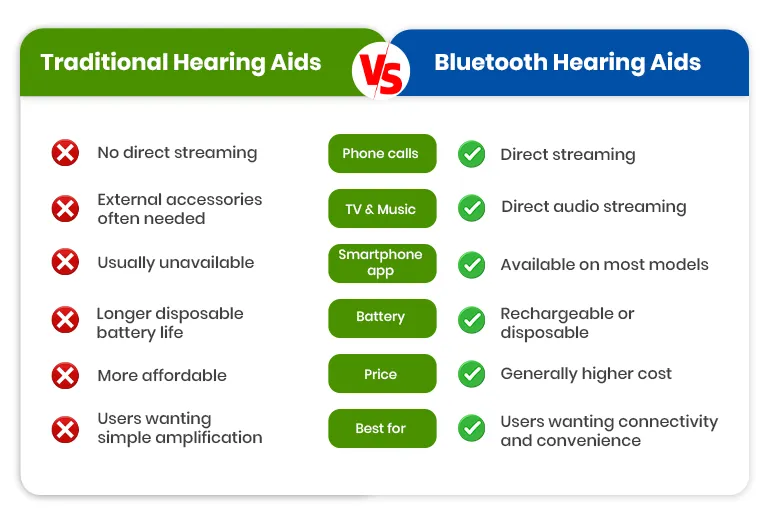
Traditional vs. Bluetooth Hearing Aids: At a Glance

Traditional vs. Bluetooth Hearing Aids

Which Hearing Aid Is Right for You?

Choosing the right hearing aid device is an important step toward better hearing and managing everyday situations with comfort and confidence.

Below is a quick comparison between traditional and Bluetooth-enabled hearing aids:

Traditional hearing aids may be the better choice if you:

  • Want a more affordable solution.
  • Rarely use a smartphone.
  • Prefer simple controls.
  • Primarily need speech amplification.

Bluetooth hearing aids may be ideal if you:

  • Frequently use your smartphone.
  • Watch TV often.
  • Take many phone calls.
  • Want rechargeable technology.
  • Prefer automatic adjustments and app controls.

Conclusion

When it comes to choosing between traditional and wireless hearing aids, the choice rests with the user and their preference. This choice also depends on the budget and the type of hearing loss.

For many people, investing in advanced technology leads to clearer communication, easier daily living, and a more comfortable listening experience. However, there are quality options available at every price point.

At our Calgary hearing clinic, we help you compare different models, understand their value, and choose a hearing aid that fits both your budget and your hearing needs.

Whether you’re considering traditional hearing aids or the latest Bluetooth hearing aids, a professional hearing test in Calgary can help you choose the right solution. If you’re looking for expert guidance, visit Prime Hearing Clinic for a hearing test, explore the latest hearing aid technology, and receive personalized recommendations.

Book a Hearing Test

Frequently Asked Questions

Traditional and Bluetooth hearing aids have the same purpose: assisting with hearing loss concerns. With Bluetooth hearing aid devices, users can easily stream phone calls, music, TV audio, and other media directly from compatible devices. On the other hand, traditional hearing aids are designed to amplify sound and improve speech clarity.

Bluetooth hearing aid devices offer better convenience through seamless connectivity. If you frequently use smartphones, watch TV, or want a more connected listening experience, Bluetooth hearing devices may be a better choice. Traditional hearing aids are a great option for those who prefer simplicity or a more budget-friendly solution.
Many modern Bluetooth hearing aids are also rechargeable hearing aids. These allow users to enjoy all-day performance without replacing disposable batteries. Rechargeable models are convenient, easy to maintain, and environmentally friendly.
The best hearing aid choice depends on your hearing test results and lifestyle. For people with severe or profound hearing loss, Behind-the-Ear (BTE) hearing aids are often recommended because they provide greater amplification and can provide more advanced features.
Bluetooth streaming can consume more battery power than standard hearing aid use. Most modern rechargeable hearing aids are designed to provide a full day's performance, even with regular streaming.

Tags: