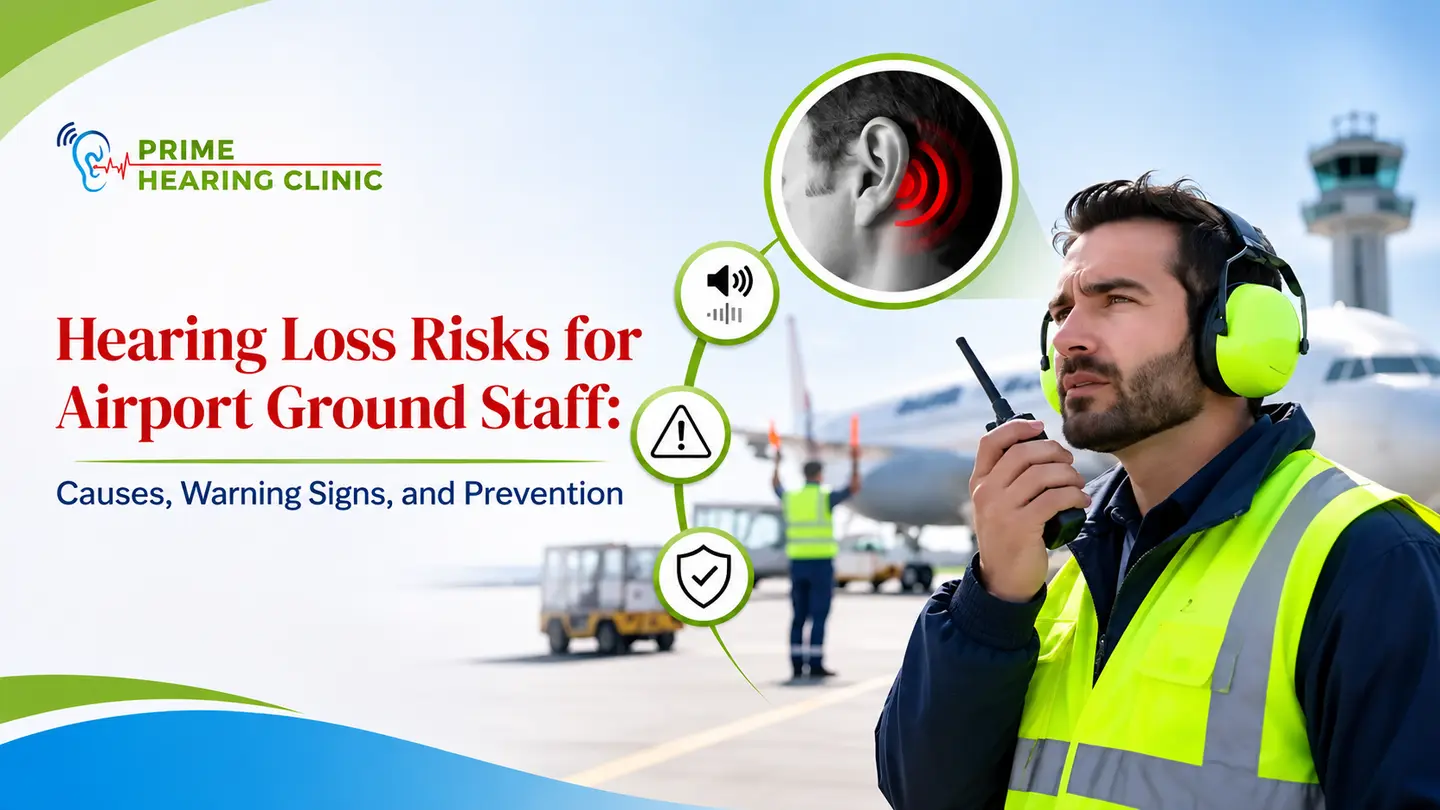
Airport ground staff work in a busy environment where loud sounds are part of their daily routine. Now, we’re not just talking about the noise of jumbo jets taking off or landing, but rather the everyday sounds around them. These include auxiliary power units, baggage-handling equipment, ground support vehicles, and the constant chatter of people moving about.
Constant exposure to loud noise can slowly damage the sensitive structures inside the ear. The effects may not be noticeable at first, which is why understanding hearing loss in airport ground staff is important for both workers and employers.
In this guide, we’ll explain the common sources of airport noise, point out early warning signs of hearing damage, and offer practical tips to protect your hearing at work.
Airport ground staff work in environments where several sources of noise can occur at the same time. Aircraft engines, auxiliary power units, ground power equipment, air conditioning systems, and baggage handling machinery can all contribute to workplace noise exposure.
Unlike passengers, who are generally exposed to airport noise for a limited period, ground staff may work around these sources every day throughout their shifts. The risk depends on how loud the noise is, how long an employee is exposed, and how frequently exposure occurs. Repeated exposure to loud noise can damage the sensitive structures inside the inner ear and may cause noise-induced hearing loss. The condition usually develops slowly as long exposure damages the tiny sensory hair cells responsible for converting sound vibrations into signals that the brain can understand.
Once these sensory hair cells are damaged, they do not naturally regenerate. This is one of the biggest reasons why early detection is important.
According to Alberta’s Occupational Health and Safety (OHS) Code, the permissible noise exposure limit is 85 dBA over an eight-hour workday. As noise levels increase, the allowable exposure duration decreases. For example, exposure at 88 dBA is limited to four hours, while 91 dBA is limited to two hours.
Source: Alberta Occupational Health and Safety Code – Part 16: Noise.
It’s not necessary that every airport employee experiences the same level of noise exposure. The risk depends on the job, equipment being operated, nearness to the aircraft and duration of the exposure.
Baggage handlers have the job of loading and unloading luggage from the aircraft, transporting baggage carts and operating conveyor systems. Most of these tasks are usually performed close to parked aircraft where auxiliary power units and other ground equipment may continue running.
A 2026 field study published in Applied Sciences found baggage handlers to be the highest-priority group for noise protection during aircraft turnaround operations. Their long duration of work beneath aircraft and close proximity to operating auxiliary power units (APUs) lead to their increased occupational noise exposure.
This makes occupational hearing protection for baggage handlers an important part of workplace safety planning.
Ramp agents may work near aircraft engines, ground power units, air conditioning equipment, and service vehicles. They are responsible for coordinating aircraft movements, preparing parking areas, and coordinating turnaround activities.
The combination of these noise sources can increase their overall exposure throughout a shift.
Staff responsible for refuelling the aircraft often work close to the fuel service equipment during turnaround operations. Power units and nearby ground machinery may contribute to serious noise exposure.
The risk often increases as the duration of each refuelling task and the number of aircraft serviced increase.
Ground support equipment at an airport often generates engine noise, mechanical vibrations, alarms, and other sounds from nearby equipment. Working around several of these machines at once can make it harder to recognize how much noise someone is exposed to over their entire shift.
People maintaining the aircraft and cleaning crews may work around powered tools, compressors, and aircraft equipment. The exposure, however, depends on the duties being performed; constant or repeated work in noisy areas can also contribute to work-related hearing damage.
Don’t Wait for Your Hearing to Get Worse. Get It Checked.
Whether you’re experiencing difficulty following conversations, frequently turning up the volume, or simply due to a routine checkup, a hearing test can help you understand your hearing health. Book a hearing test in Calgary with our experienced team and take the first step towards better hearing.
Noises at an airport do not come from one single source. Ground staff often move between different work areas. Understanding these sources helps workers and employers find areas requiring better noise control.
Aircraft engines produce very loud and powerful sounds during engine start-up and other similar operations. Employees working in close proximity during these activities may experience intense noise exposure. Several factors, such as the type, engine condition and duration, among others, substantially increase the risk.
An auxiliary power unit, also called an APU, is a small power unit located in the tail of the aircraft. The purpose of this unit is to supply electrical power for functions other than propulsion. This unit is usually smaller than the main engine, but it can still generate considerable noise. People working closer to the aircraft during turnaround operations may experience repeated exposure.
Electrical power to parked aircraft is supplied through ground power units. Depending on the operating conditions, these units can enhance the overall noise in the apron area. Their noise output may vary with the equipment used and the duration of operation.
Several machines at an airport, such as conveyor belts, baggage loaders, tractors and other equipment, produce noise during everyday operations. Workers who spend several hours around these systems may be prone to ongoing exposure, even when no aircraft engines are running nearby.
Employees working at an airport are rarely exposed to just one sound source. A baggage handler may start their shift around conveyor systems, move to an aircraft stand during unloading and later work near service vehicles and ground power equipment.
Even when tasks are isolated, their combined noise exposure may create a greater risk over time. This is why workplace noise hearing tests should consider the worker’s actual duties and total exposure rather than depending on occasional sound-level readings.
One of the biggest challenges with occupational noise-induced hearing loss is that it often develops gradually. Workers may fail to notice the changes immediately because they become used to their surroundings.
A ringing, humming, buzzing, or whistling sound without an external source is known as tinnitus.
Workers may notice it after a noisy shift, while others may experience it more often in quiet surroundings.
Tinnitus does not always mean permanent hearing loss. Recurring symptoms after noise exposure should not be ignored. You should consult a professional at a reliable hearing clinic.
Workers may hear someone speaking but find it difficult to understand the words, especially when several people are talking or machinery is running by. This can be an early warning sign of high-frequency hearing difficulties.
If you find yourself asking people to repeat themselves often, it may indicate a change in hearing ability. This difference is more noticeable when communication takes place over radios or in busy operational areas. If you have been noticing similar changes in your hearing ability, it’s recommended to get a hearing health assessment.
Often after spending time in a noisy environment, some employees may start experiencing temporary muffled hearing or feel like their ears are blocked. This can point to a temporary change in hearing sensitivity.
Even if your hearing seems to return to normal after resting, repeated exposures should be taken seriously because they can hint at hazardous noise exposure.
Hearing changes can make it harder to recognize certain warning sounds, especially high-frequency signals. For airport ground staff, this may affect communication with colleagues and awareness of workplace hazards.
The answer to this question depends on the type and extent of hearing damage. Some workers may experience a temporary threshold shift after exposure to loud noise. Their hearing may seem muffled for a period but improve after they spend time away from the noise.
However, repeated exposure can damage the inner ear permanently. Permanent noise-induced hearing loss cannot currently be reversed through medication or surgery.
Hearing aids and other assistive listening devices can help people manage communication difficulties caused by permanent hearing loss, but they do not restore the damaged sensory hair cells.
Preventing hearing damage from airport noise requires more than simply wearing earplugs. Workers and employers need to understand the noise hazards, select appropriate protective equipment, and monitor hearing over time.
Here are some practical measures that can help:
Employers should assess the levels of noise in different work areas and identify tasks that put employees at risk of harmful sound levels.
Noise dosimeters and suitable sound-level meters can help measure exposure. Personal dosimetry is useful when workers move between different locations throughout a shift.
The assessment should consider:
Hearing protection for airport workers may include earplugs, earmuffs, or other approved hearing protection devices. The right choice depends on the noise level, work activity, and comfort.
For example:
Disposable foam earplugs can be suitable for certain noisy tasks when correctly fitted. Reusable earplugs can provide a practical option for workers who need occupational hearing protection. Custom earmolds can offer an individualized fit for employees who regularly work in noisy environments.
Even when you have good quality hearing protection, it may not work as intended if it is incorrectly fitted. Insert earplugs according to the manufacturer’s instructions, and ensure earmuffs create a proper seal around the ears.
Employees should also ensure they inspect their equipment regularly and replace any damaged or worn protective devices.
Reducing noise levels before they reach workers is an important part of conserving your hearing health. Depending on the equipment and work environment, employers may consider:
Hearing tests for airport workers can help identify changes in hearing sensitivity, including those that may not yet affect everyday conversations. Baseline and follow-up hearing assessments provide useful information about hearing changes over time.
Workers exposed to hazardous noise should follow their employer’s hearing conservation programme and applicable occupational health requirements. Regular testing is important for employees who have worked in noisy environments for several years or have started noticing symptoms such as tinnitus or difficulty understanding speech.
Requirements for workplace hearing protection depend on the employer’s regulatory jurisdiction and the worker’s exposure. This is especially important for employees at Calgary International Airport because air transportation, including airports and airlines, is generally covered by federal occupational health and safety legislation.
Under Part 16 of Alberta’s OHS Code:
Many airport and airline operations come under the Canada Labour Code and its occupational health and safety regulations.
As of November 2026, federal noise regulations must not be confused with the proposed amendments published in the Canada Gazette on March 21, 2026.
Those proposed changes include lowering the eight-hour noise exposure limit from 87 to 85 dBA and introducing stronger hearing-loss prevention requirements.
Employers and workers should check the regulations currently applicable to their workplace rather than assume that the proposed amendments are already in force.
For more information, consult:
Hearing damage is not always clearly evident in its early stages. Workers may continue their day-to-day activities without realizing that their hearing sensitivity has changed. A professional hearing assessment helps evaluate how well a person detects different sounds and frequencies. It is also helpful for understanding severity and whether a clinical assessment is needed.
Depending on the assessment, a hearing test may include:
Pure-tone audiometry: Helps measure the softest sounds a person can hear at different frequencies. The results are recorded on an audiogram, which helps identify the degree and type of hearing loss.
Speech testing: Is used to evaluate how well a person hears and understands spoken words. The test helps provide additional information about everyday communication difficulties.
Tympanometry: Evaluates eardrum movement and middle-ear function. It can help point out certain middle-ear problems that may affect hearing.
The right test is usually chosen based on the person’s symptoms, history and reason for assessment.
Airport employees who usually work around aircraft engines, baggage equipment, and other noisy machinery should not delay a hearing assessment until hearing difficulties begin affecting their daily lives.
If you work at YYC Airport or in another noise-exposed occupation in Calgary, it’s recommended that you schedule a hearing assessment if you notice ringing in your ears, muffled hearing, difficulty understanding conversations, or any other changes in your hearing.
Prime Hearing Clinic provides hearing care services in Calgary. The services include hearing assessments, job-specific hearing evaluations, custom earmolds and hearing aid support.
Located at Apex Sky Medical Centre, 6004 Country Hills Boulevard NE, building 1401, the clinic is easily accessible to individuals and families across Calgary.
The clinic also offers personalized, multilingual hearing care in English, Punjabi, Hindi and Urdu. Whether you are looking to understand your current hearing health or experiencing a range of early hearing changes, a professional assessment can help you make informed decisions about the next steps.
Airport ground staff working around aircraft engines, baggage handling systems and ground support equipment can be exposed to repeated noise that may affect their hearing over time. Hearing loss often develops slowly. There are some early signs such as ringing in the ears, muffled hearing, and difficulty following conversations should never be ignored.
Taking preventive steps, using properly fitted hearing protection and keeping up with regular hearing assessments can help workers protect their long-term hearing health.
Your hearing is important for communication, workplace awareness, and everyday life. If your job involves regular exposure to aircraft and machinery noise, make hearing health part of your routine.
Contact Prime Hearing Clinic to arrange a hearing test in Calgary and get personalized guidance on maintaining your hearing health.
Baggage handlers, ramp agents, aircraft refuelling personnel, ground support equipment operators and aircraft maintenance workers may experience higher noise exposure because of their proximity to operating aircraft and machinery. Individual risk depends on their duties and measured noise exposure.
There are several signs that may include difficulty understanding conversations, frequently asking people to repeat themselves, ringing in the ears, and muffled hearing after noisy shifts. Some workers may also struggle to hear certain high-frequency sounds.
Workers exposed to excess occupational noise should follow the hearing testing requirements applicable to their workplace. Baseline and follow-up audiometric tests can help identify changes in hearing sensitivity and support hearing conservation programmes.
Custom-moulded earplugs can provide a personalized fit and may be suitable for workers who need regular hearing protection. However, the appropriate level of protection depends on the noise exposure and the device's verified attenuation. They should be selected as part of a workplace hearing protection programme.
Permanent noise-induced hearing loss cannot currently be reversed. However, with hearing aids and other assistive listening devices, you can manage communication difficulties.
Alcohol Consumption Affect Assistive Listening Devices Bluetooth hearing aids communication tips for seniors with hearing loss Custom earmolds Custom earplugs in Calgary hearing-aid practitioners in Calgary hearing aid clinic in Calgary hearing aid clinics in Calgary hearing aid devices Hearing aid practitioners Hearing aid practitioners in Calgary Hearing Aids hearing aids in Calgary hearing care services in Calgary hearing clinic in Calgary hearing clinics in Calgary hearing health clinic in Calgary Hearing Protection Hearing Screening Hearing Test hearing test in Calgary hearing tests in Calgary Hidden Risk of Cotton Swabs in-clinic hearing test Sudden Hearing Loss Wireless Hearing Aids wireless hearing devices Workplace Hearing Safety
We Speak Your Language

Supporting individuals and families across Alberta with better hearing through expert care, advanced technology, and compassionate service, both in-clinic and in-home.
ਸਾਡਾ ਮਿਸ਼ਨ ਹੈ ਕਿ ਹਰ ਕੋਈ ਵਧੀਆ ਢੰਗ ਨਾਲ ਸੁਣ ਸਕੇ—ਕਿਉਂਕਿ ਸੁਣਨਾ ਜ਼ਿੰਦਗੀ ਨਾਲ ਜੁੜਨ ਦਾ ਸਾਧਨ ਹੈ।
Copyright © 2026 Prime Hearing Clinic. All Rights Reserved.
Powered By Cyber Ace
Our booking services are currently available exclusively in Canada. We’re sorry, but bookings from outside Canada are not currently supported.